Condition, rarity, and demand quietly reshape a familiar face.
Andrew Jackson, the seventh US President, appears on the $1 coin released under the Presidential $1 Coin Program.
This series started in 2007.
The coin featuring Jackson's portrait entered circulation on August 14, 2008.
Total mintage exceeded 122 million units.
Despite mass production, the market Andrew Jackson dollar coin value significantly exceeds the face value.
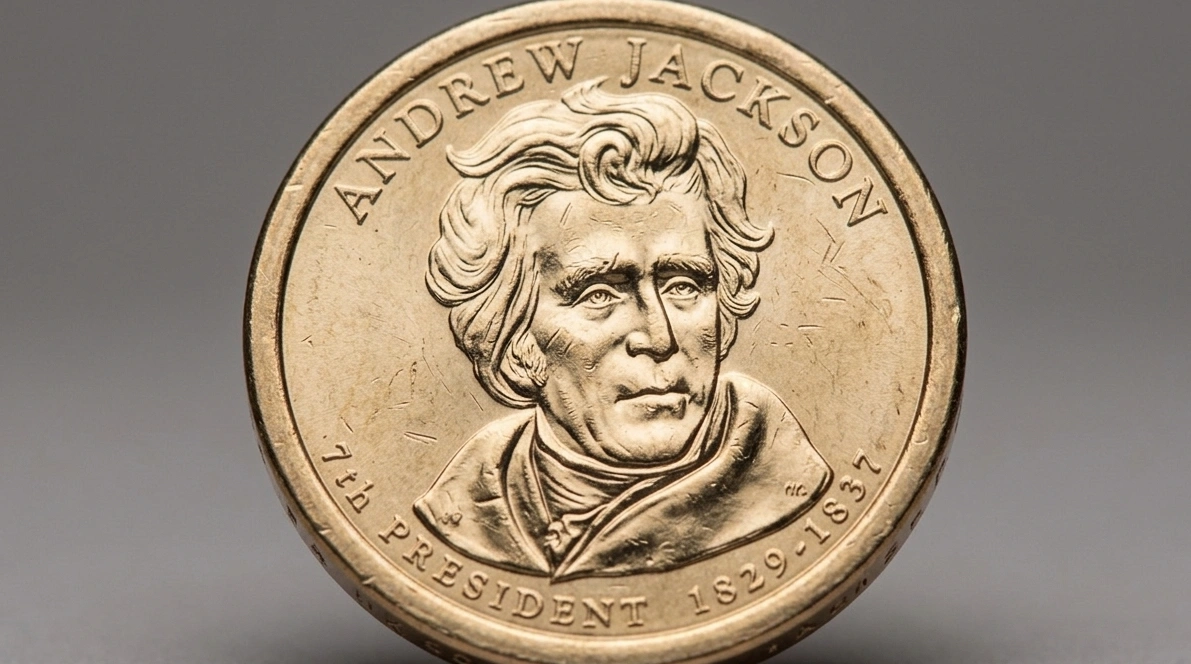
Parameter | Value |
Nominal Value | $1.00 |
Total Weight | 8.1 grams |
Diameter | 26.5 mm |
Thickness | 2.0 mm |
Core Material | 100% Copper |
Outer Layer | Copper-Zinc-Manganese-Nickel Alloy |
Shape | Round |
Verifying weight and size helps identifying counterfeit items.
Deviations in mass often indicate a fake coin or a rare blank defect.
Production Volume by Mint Mark
Market price directly correlates with the production volume at a specific facility.
Philadelphia (P): 61,180,000 units
Denver (D): 61,070,000 units
San Francisco (S): 3,083,940 units → exclusively for collector sets
The San Francisco mint produced 20 times fewer coins than the main facilities.
Low mintage makes coins marked with "S" highly desirable in Proof condition.
Grading Influence on Market Price
Professional grading from 1 to 70 determines the final market position.
Certification by PCGS or NGC establishes the coin's authenticity and quality.
Circulated coins → $1.00
High-grade specimens (MS65 and higher) → $5.00 – $50.00
Record grades (MS68) → $1,000.00 and more
Price increases exponentially moving from MS67 to MS68.
Statistics show a 3-5% annual value growth for coins in the highest possible grades.
Ordinary coins from circulation show 0% price growth over the last decade.
Edge Lettering Variations
Edge lettering remains a key feature of the Presidential Dollar series.
The rim contains the year, mint mark, and national mottos.
Two types of lettering placement exist relative to the portrait.
Position A: lettering reads correctly with the president's face up.
Position B: lettering appears upside down relative to the portrait.
These variations represent standard production methods rather than errors.
Collectors seeking complete sets create steady demand for both versions.
Minting Errors: Primary Value Drivers
Production defects represent the highest value for the market.
Manufacturing flaws transform a common dollar into an expensive asset.
Missing Edge Lettering
Such coins feature a smooth rim. Values range from $50.00 to $200.00.
Double Edge Lettering
A blank passing through the machine twice creates overlapping text. Prices reach $300.00 – $500.00 depending on clarity.
Partial Lettering
Weak strikes or missing individual letters. Values stay between $20.00 and $40.00.
Sales records for coins with errors often exceed initial estimates.
In 2012, an MS67 specimen with missing edge lettering sold for over $1,000.00.
2026 Market Analytics and Investment Potential
The $1 coin market shows high volatility for mid-range grades.
Investors track data from Heritage Auctions and Stack’s Bowers.
Year | Price (P) | Price (D) | Trend |
2020 | $22.00 | $20.00 | Base |
2022 | $28.00 | $25.00 | +27% |
2024 | $35.00 | $32.00 | +25% |
2026 | $42.00 | $38.00 | +20% |
Steady price increases of 20-25% every two years apply only to certified coins.
Uncertified coins do not show such dynamics.
Comparison with 2008 Presidential Issues
The Mint released four presidential coins in 2008.
James Monroe → John Quincy Adams → Andrew Jackson → Martin Van Buren.
Production volumes help assessing Jackson's relative rarity.
James Monroe: 124,490,000
John Quincy Adams: 115,220,000
Andrew Jackson: 122,250,000
Martin Van Buren: 102,480,000
Jackson's dollar holds the second-highest mintage for that year.
Large supply prevents significant price growth for common specimens.
Surface Composition and Oxidation Factors
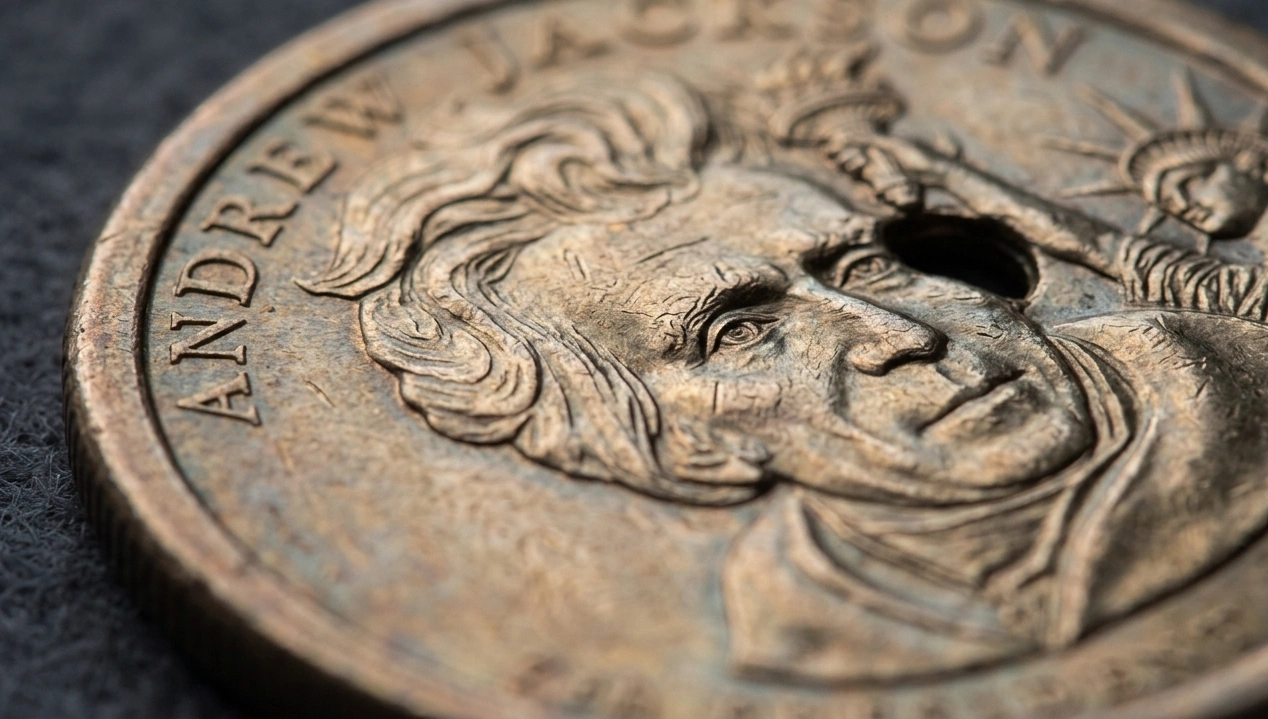
The coin's surface contains an alloy sensitive to air exposure.
Manganese in the alloy causes rapid oxidation.
Contact with oxygen turns the coin brown or creates spotted patches.
Specimens retaining original golden luster command higher prices.
Patina presence either increases or decreases the final value.
Rainbow Patina → attracts buyers paying up to 50% premium.
Dark/Dirty Patina → lowers the grade and market liquidity.
Certification Costs and Feasibility
Determining value requires accounting for authentication expenses.
Shipping to a grading service.
Paying the grading fee (approximately $25.00 – $40.00).
Covering logistics and insurance costs.
Or check it for free via a free coin value checker
Submitting a coin with a market value below $50.00 remains economically impractical.
This creates a shortage of certified coins in average grades.
Special Collector Sets Impact
The US Mint produced special sets for collectors.
Satin Finish Set (2008).
These coins feature higher minting quality compared to circulation strikes.
Total production reached approximately 745,464 sets.
Individual coins from these sets cost between $10.00 and $15.00.
Not intended for circulation, these coins preserve their features longer.
Demand Structure: Market Participants
Several groups form the demand for Jackson dollars.
Date-set collectors → buying MS65-MS66.
Error hunters → searching for Missing Edge Lettering.
High-grade investors → targeting MS68.
Online marketplace sellers → trading circulated lots.
Market segmentation ensures asset liquidity at various price levels.
Record Auction Sales
Historical transactions provide evidence of value peaks.
Specimen | Grade | Sale Price | Date |
2008-P Jackson | MS68 | $1,150.00 | 2015 |
2008-D Jackson | MS68 | $920.00 | 2017 |
2008-P (No Edge) | MS67 | $450.00 | 2019 |
2008-S (Proof) | PR70DCAM | $160.00 | 2021 |
These figures confirm the importance of the highest preservation state.
The gap between MS67 and MS68 often exceeds $800.00.
Risks and Counterfeit Prevention
Cases of coin modification exist despite the low face value.
Fraudsters grind down the rim to mimic the Missing Edge Lettering error.
Checking the weight (8.1 grams) and examining the coin via a Check Coin Value app helps identifying tampering.
Removing the edge lettering reduces weight by 0.1 – 0.2 grams.
Using precise digital scales remains a mandatory step in appraisal.